
What Is Agentforce Revenue Management?
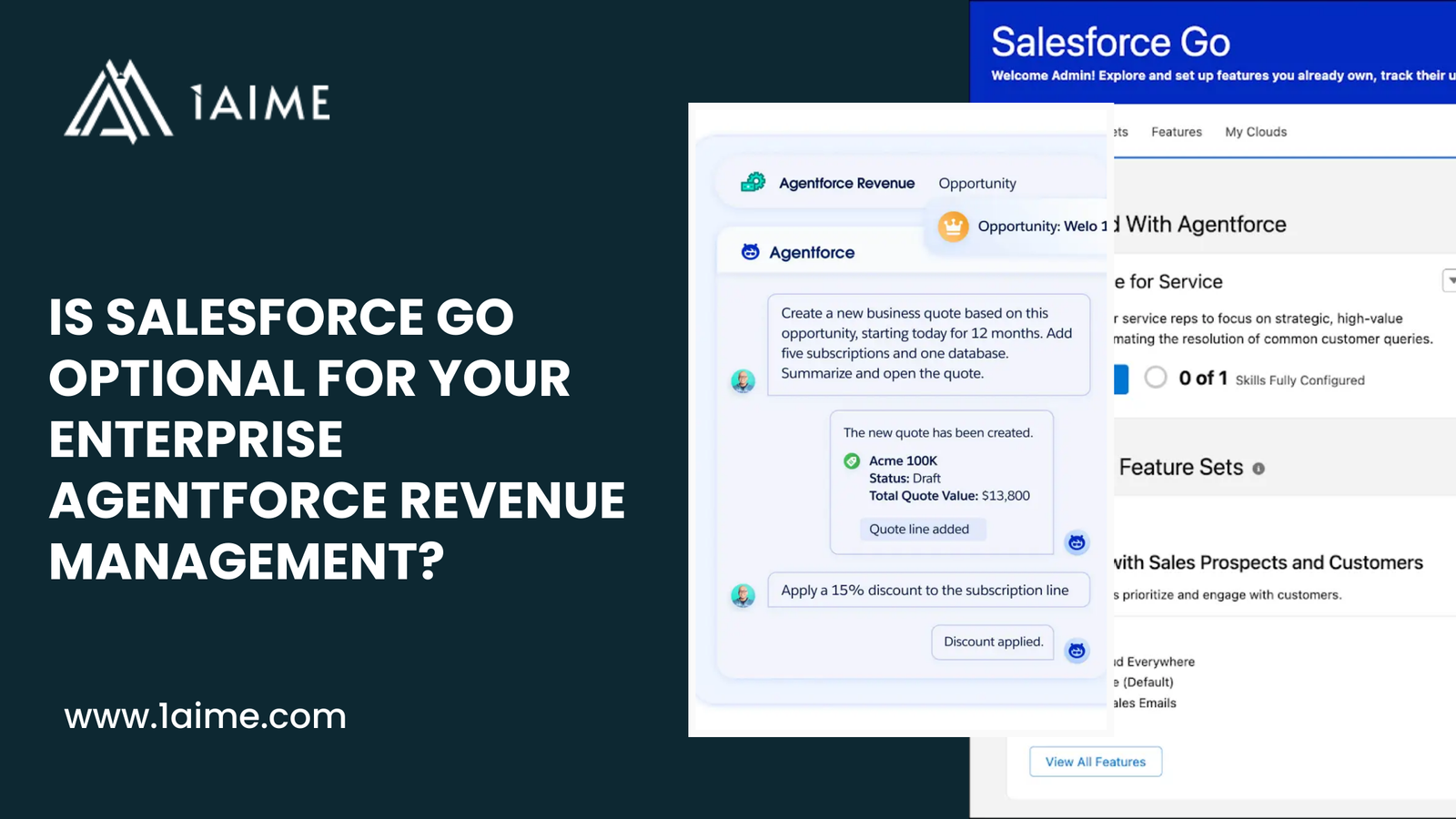
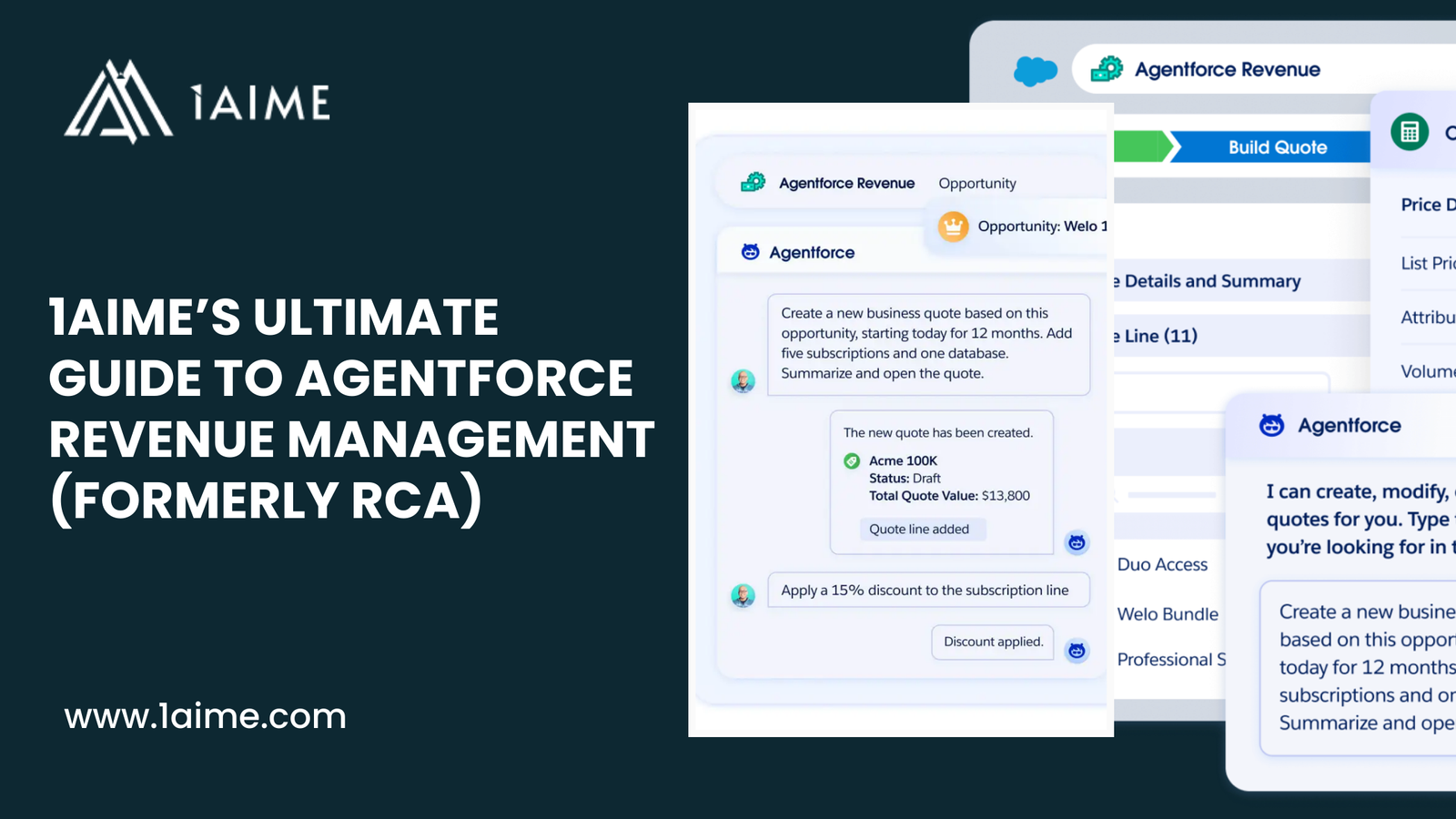
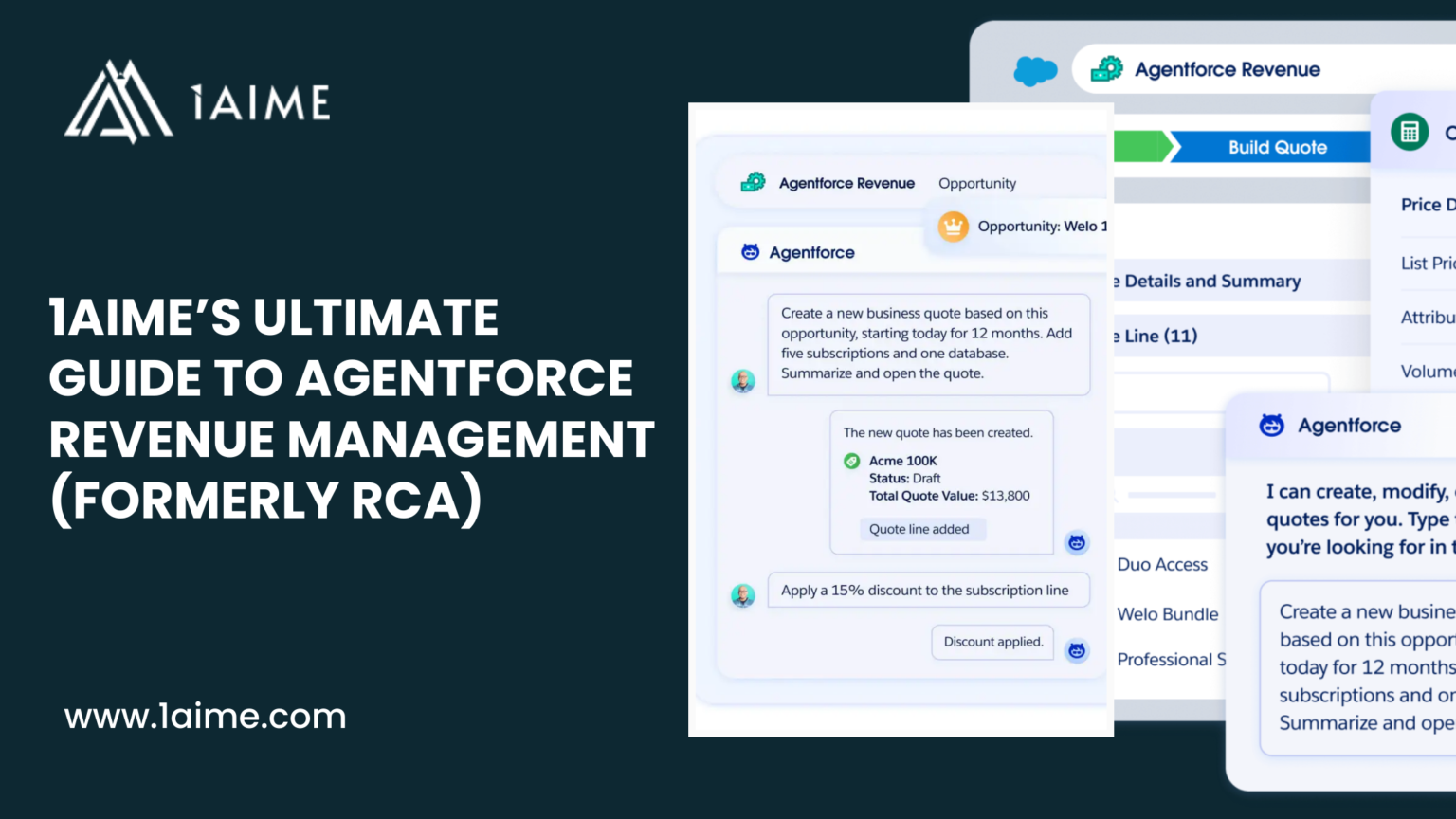
Agentforce Revenue Management was previously known as Revenue Cloud Advanced, the successor of Salesforce CPQ. Salesforce rebranded RCA to Agentforce Revenue Management as part of its Agentforce platform strategy to unify revenue operations with AI-driven execution across the full revenue lifecycle.
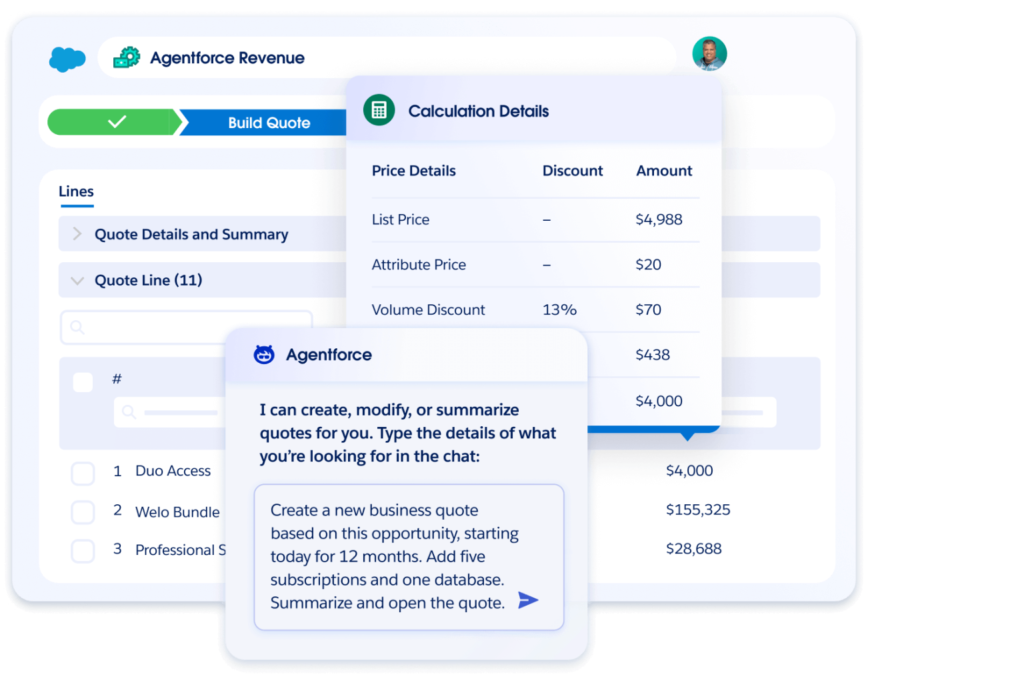
ARM is an AI-enabled revenue orchestration layer that connects commercial intent with financial execution on CRM. It standardises product data, pricing logic, contract structures, order execution, and revenue analytics across the full revenue lifecycle. AI agents operate inside this layer to guide decisions, execute actions, and maintain accuracy at scale.
The purpose of Agentforce Revenue Management is revenue control across the entire revenue lifecycle. It ensures:
- Consistent product and pricing logic across all channels
- Accurate quote creation and order execution
- Contract governance and commercial compliance
- Controlled amendments, renewals, and expansions
- Precise billing and usage accountability
- Reliable revenue metrics and financial visibility
Also Read: ChatGPT vs Agentforce: Reasoning and Execution in Salesforce-Driven Enterprises
RCA Rebranding VS ARM Platform Evolution
Revenue Cloud Advanced already supported the full revenue lifecycle with AI-assisted capabilities across quoting, contracts, billing, subscriptions, and analytics. The rebrand to Agentforce Revenue Management represents an evolution in scope and execution rather than a reset of functionality. Salesforce repositioned RCA under Agentforce to reflect deeper AI agent participation, broader monetization scenarios, and tighter orchestration across complex revenue models and industries.
To be clear, Agentforce Revenue Management expands how existing capabilities operate together on a unified platform.
| Aspect | Revenue Cloud Advanced (RCA) | Agentforce Revenue Management (ARM) |
| Lifecycle coverage | Full revenue lifecycle | Full revenue lifecycle with agent-led execution |
| AI capability | Embedded AI assistance | Expanded AI agents with execution authority |
| Platform role | Revenue Cloud solution | Agentforce platform revenue pillar |
| Quoting and billing | Unified and automated | Unified with deeper orchestration |
| Revenue models | Transactional, subscription, usage | Transactional, subscription, usage, advertising |
| Channel support | Multi-channel | Multi-channel with agent coordination |
| Automation depth | Rule-based and process automation | Agent-driven automation and prediction |
| Analytics scope | Revenue and subscription analytics | Predictive revenue and monetization intelligence |
| Strategic positioning | Advanced revenue capability | Enterprise monetization platform |
Read More: What Salesforce RCA Rebranding to Agentforce Revenue Management Really Signals?
Agentforce Revenue Management vs Legacy CPQ
Salesforce CPQ focuses on accurate configuration, pricing, and quote creation at the sales stage. Agentforce Revenue Management extends beyond quoting to control revenue execution across contracts, orders, billing, renewals, and analytics. CPQ optimises deal creation whereas ARM governs the full revenue lifecycle.
| Dimension | Legacy Salesforce CPQ | Agentforce Revenue Management (ARM) |
| Primary purpose | Quote accuracy and deal configuration | Enterprise-wide revenue control |
| Lifecycle coverage | Configure, price, quote | Quote to cash with renewals and expansion |
| Revenue scope | Sales-stage monetisation | Full commercial and financial execution |
| Product logic | Rule-based configurations | Unified product and revenue logic |
| Pricing control | Discounts and deal pricing | Pricing, billing, and monetisation models |
| AI role | Assisted recommendations | Agent-driven execution and guidance |
| Revenue models | Primarily transactional | Transactional, subscription, usage, hybrid |
| Channel support | Sales-led channels | Direct, partner, and digital channels |
| Order management | Limited or external | Native orchestration and fulfilment |
| Billing and invoicing | External or downstream systems | Native billing and invoice intelligence |
| Renewals and assets | Add-on or manual | Native asset and subscription lifecycle |
| Analytics focus | Quote and sales metrics | Revenue, margin, retention, and cash metrics |
| Strategic role | Sales productivity tool | Revenue operations platform |
How Agentforce Revenue Management Works?
Let’s suppose your organisation manages subscription and usage-based revenue across direct and digital channels. Agentforce Revenue Management acts as the single revenue control layer on Salesforce CRM. The platform applies shared product data, pricing logic, contract rules, and billing structure across every revenue action. AI agents operate inside this layer to execute revenue tasks with accuracy and consistency.
This is how Agentforce Revenue Management works in practice:
- An opportunity opens in CRM with unified product and pricing logic available
- Valid products, licences, and usage rates appear from one catalogue
- AI agents create a compliant quote based on approved rules
- The quote converts into an order on the same platform
- Contract terms generate from approved templates with governance applied
- Assets and entitlements activate after order confirmation
- Usage data records against contracted limits in real time
- Billing reflects subscription charges and actual usage
- Invoices reference pricing logic, contract terms, and usage records
- Amendments update live contracts with consistent pricing
- Renewal proposals generate from asset state and usage trends
- Revenue metrics update instantly across subscriptions and usage
Revenue Models and Channels Supported
Agentforce Revenue Management supports revenue growth across every channel and every commercial model on a single platform. The system applies one product catalogue, one pricing structure, and one contract framework across the organisation. AI agents execute revenue actions consistently, which removes channel friction and model complexity. Revenue teams scale without rebuilding processes for each route to market.
Revenue models supported by Agentforce Revenue Management:
- Transactional revenue with one-time product or service sales
- Subscription revenue with term-based pricing and renewals
- Usage-based revenue tied to consumption and entitlements
- Hybrid revenue models that combine subscriptions, usage, and one-time charges
- Advertising and media revenue with full lifecycle visibility
Channels supported by Agentforce Revenue Management:
- Direct sales through CRM-led selling
- Partner and reseller channels with shared revenue logic
- Digital and self-service channels with automated execution
- Multi-channel environments using the same pricing and contract rules
How ARM enables consistency across models and channels:
- A unified product catalogue exposes offerings across all channels
- A central pricing engine applies approved pricing structures everywhere
- AI agents generate quotes and orders regardless of entry point
- Contracts govern revenue terms across the lifecycle
- Billing follows the same logic for every model and channel
Agentforce Revenue Management Features and Functions
Agentforce Revenue Management provides a complete set of features and functions that control revenue execution across products, pricing, contracts, orders, billing, and analytics. All capabilities operate on a unified platform and support all revenue models and channels with governed logic and AI-driven execution.
| Category | Features and Functions |
| Product Management | Unified product catalogue, attribute-based product modelling, SKU rationalisation, PIM, PLM, ERP integration |
| Pricing | Central pricing engine, tiered pricing, volume pricing, usage pricing, hybrid pricing, pricing sequence control, pricing calculation visibility |
| Configuration | Constraint Builder, rule-based configuration, guided selling, complex product configuration |
| Quoting | Automatic quote generation, quote updates, quote versioning, intelligent bundling, upgrade and add-on recommendations |
| Contracts | Contract creation, contract updates, clause libraries, contract templates, contract version control |
| Contract Changes | Amendments, renewals, cancellations, contract redlining, approval workflows, e-signature integration |
| Order Management | Order creation, order orchestration, commercial-to-technical order decomposition |
| Fulfilment | Orchestration plans, dependency management, real-time order change handling |
| Downstream Execution | Fulfilment initiation, billing initiation, revenue recognition initiation, compensation task initiation |
| Asset Management | Asset lifecycle tracking, entitlement management, ownership visibility |
| Subscription Management | Subscription tracking, MRR visibility, ARR visibility, quantity and term management |
| Usage Management | Consumption monitoring, usage entitlement tracking, usage-based billing |
| Billing | Invoice generation, invoice adjustments, invoice explanation, billing accuracy controls |
| Analytics | Pricing analytics, margin analytics, subscription revenue analytics, order analytics, billing analytics |
| Automation | Automated pricing, automated discounts, automated campaigns, automated revenue workflows |
| AI Agents | Quote generation, renewal management, consumption monitoring, invoice explanation |
| Predictive Intelligence | Churn risk identification, upsell identification, renewal forecasting |
| Platform Coverage | Multi-channel support, multi-revenue-model support, unified CRM execution |
Agentforce Revenue Management Components
Agentforce Revenue Management operates as a coordinated set of revenue components on a single platform. Each component performs a defined role, while all components share the same data, pricing logic, and governance model. This structure ensures revenue execution remains consistent from product configuration through cash collection.
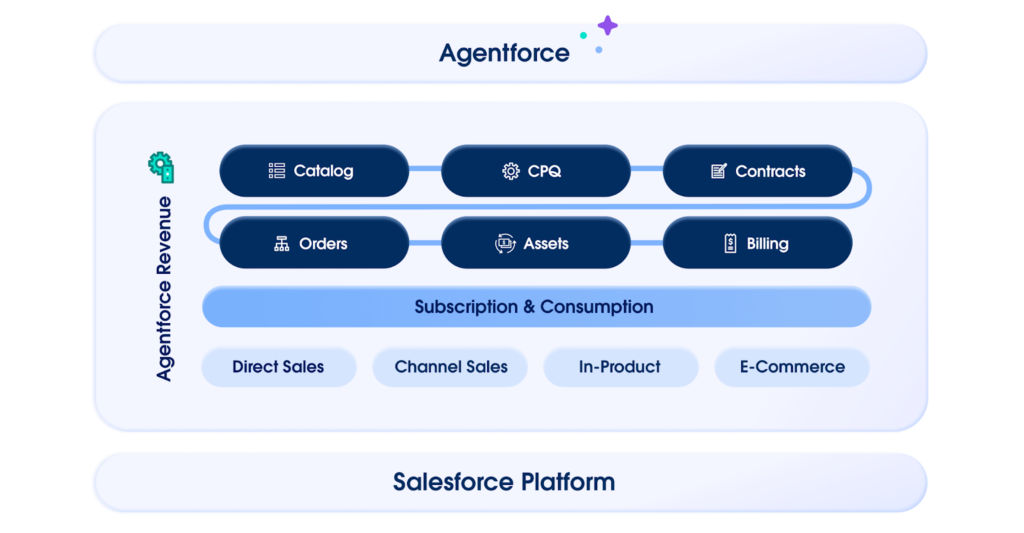
- The product catalogue defines all products, services, and attributes available for sale. It acts as the foundation for pricing, configuration, and channel exposure. Every revenue action references this catalogue, which prevents duplication and inconsistency across channels.
- The CPQ component applies configuration rules, pricing logic, bundles, and discounts to create accurate quotes. It ensures that every quote reflects approved product combinations and pricing structures. Quotes generate directly from CRM and remain aligned with downstream execution.
- The contracts component governs commercial terms across the lifecycle. Contracts generate from approved templates and clauses, then control renewals, amendments, and obligations. This ensures pricing, duration, and entitlement terms remain enforceable throughout the customer relationship.
- The orders component translates commercial agreements into executable orders. It prepares fulfilment actions and coordinates downstream processes without manual handoffs. Order changes reflect instantly across related revenue records.
- The assets component represents customer ownership. It tracks active products, subscriptions, quantities, and entitlements in real time. Asset data provides the foundation for renewals, amendments, and expansion activity.
- The billing component generates invoices based on contract terms, pricing rules, and recorded usage. It supports recurring charges, usage-based billing, and hybrid models with accuracy and traceability.
- Subscription and consumption act as a shared foundation across all components. Subscription terms define recurring revenue structure. Consumption tracking records usage against entitlements. Together, they enable predictable recurring revenue and accurate usage monetisation.
Notably, all the components operate across multiple channels, including direct sales, partner sales, in-product experiences, and e-commerce. Each channel uses the same revenue logic, which allows organisations to scale without introducing revenue risk or operational fragmentation.
End-to-End Revenue Lifecycle With Agentforce Revenue Management
Agentforce Revenue Management governs the complete revenue lifecycle on CRM using a single execution layer. Product data, pricing logic, contract rules, order structures, asset state, and billing logic remain shared across every revenue action. Each stage builds on the previous one without data loss, reconciliation, or system handoffs. This creates continuity from first commercial intent through cash collection and renewal.
Configure, Price, and Quote From Anywhere
Configure, price, and quote from anywhere means that all product configuration, pricing logic, and quote creation operate from a single governed revenue layer, independent of channel or user. Every revenue entry point references the same product catalogue, pricing engine, and configuration rules. This ensures commercial consistency while allowing revenue to originate from sales teams, partners, and digital experiences without rework or reconciliation.
This capability includes the following core elements:
- A unified, attribute-based product catalogue shared across all channels
- Constraint-based configuration rules that enforce valid product combinations
- A central pricing engine supporting transactional, subscription, usage, and hybrid models
- Governed discounting, bundles, upgrades, and add-ons with full calculation visibility
- Quote generation directly within CRM using approved commercial logic
The benefits are operational control and execution speed at the same time. Pricing integrity remains protected without slowing deal cycles. Sellers produce accurate quotes without manual validation. Multi-channel revenue scales without introducing pricing drift, configuration errors, or approval bottlenecks.
From an executive perspective, this capability reduces revenue risk while enabling expansion across new channels. It eliminates duplicated pricing logic, fragmented configuration tools, and inconsistent deal structures that typically emerge as organisations grow.
For Example,
A company sells a core subscription with usage-based overages through direct sales and a digital checkout. A sales rep generates a quote in CRM while a customer configures the same product online. Both paths reference the same product attributes, pricing tiers, and discount rules. The quotes match in structure, pricing, and compliance, even though they originate from different channels. Revenue teams gain scale without sacrificing control.
Quote to Cash on a Single Revenue Platform
Quote to cash on a single revenue platform means that every step from quote creation through order execution, billing, and cash collection operates on one governed system. Quotes do not hand off to external tools or require re-entry. Each downstream action references the same commercial data, which preserves accuracy as revenue moves from sales to finance.
This capability includes the following platform functions:
- Direct conversion of quotes into orders and contracts without data duplication
- Order execution aligned with approved commercial terms
- Billing driven by contract structure, pricing logic, and recorded usage
- Automated invoicing and revenue recognition initiation
- Continuous data continuity across sales, finance, and operations
The primary benefit is execution reliability. Revenue teams avoid breakdowns that typically occur between quoting, contracting, and billing systems. Invoicing happens faster. Errors caused by manual handoffs decrease. Cash collection accelerates while financial accuracy improves.
From an executive perspective, a single quote-to-cash platform reduces revenue leakage and operational cost. Finance gains confidence in billing and recognition. Sales closes faster without post-deal corrections. Leadership gains a clean line of sight from booked revenue to collected cash.
For Example,
A sales team closes a complex subscription and usage-based deal. The approved quote converts directly into an order and contract on the same platform. Usage limits, pricing tiers, and billing schedules carry forward automatically. When usage occurs, invoices generate based on the original commercial terms without manual intervention. Revenue posts accurately and cash collection begins without delay.
Fuel Growth With Real-Time Account and Asset Insights
Fuel growth with real-time account and asset insights means that customer ownership, entitlements, and commercial state remain continuously visible across the revenue lifecycle. Every product, subscription, quantity, and usage entitlement becomes an active asset on CRM. Revenue decisions rely on live ownership data rather than historical orders or disconnected reports.
This capability includes the following insight layers:
- Real-time visibility into active products, subscriptions, quantities, and entitlements
- Continuous asset updates following amendments, renewals, cancellations, or expansions
- Usage tracking aligned to contracted limits and pricing tiers
- Revenue metrics derived directly from asset state, including ARR, NRR, and MRR
- Renewal and expansion signals generated from actual ownership and consumption data
The benefit is controlled, predictable growth. Renewals originate from what customers actually own and use. Expansion opportunities surface through asset visibility rather than manual analysis. Churn risk becomes identifiable earlier through changes in usage, asset state, or contract timing.
From an executive standpoint, asset-driven insight shifts revenue growth from reactive to intentional. Forecasts improve because revenue metrics reflect live commercial reality. Sales, success, and finance operate from the same customer view, which reduces friction and improves accountability.
For Example,
A customer holds multiple subscriptions with usage-based entitlements. Asset records show declining consumption on one product and increasing usage on another. Renewal proposals generate directly from current asset state, while expansion opportunities align with observed usage growth. Revenue teams act based on evidence rather than assumptions, which improves retention and increases lifetime value.
Manage the Entire Contract Lifecycle on CRM
execution from creation through renewal. Contracts do not sit in external systems or static documents. Each contract stays linked to opportunities, quotes, assets, orders, and billing records, which ensures commercial terms continue to govern revenue after signature.
This capability includes the following contract controls:
- Contract generation directly from opportunities and approved quotes
- Standardised templates and clause libraries to enforce legal governance
- In-CRM redlining, approvals, and e-signature workflows
- Contract version control across amendments, renewals, and cancellations
- Obligation tracking tied to active assets and fulfilment milestones
The benefit is sustained commercial control. Legal compliance holds beyond the initial deal. Sales and finance avoid misalignment caused by contract data living outside CRM. Contract changes reflect immediately across billing, assets, and revenue metrics, which reduces downstream risk.
From an executive perspective, lifecycle contract management reduces operational cost and exposure. Deal velocity increases because contract creation and negotiation stay within the sales flow. Post-signature execution improves because obligations and entitlements remain enforceable throughout the customer relationship.
For Example,
A customer requests a mid-term contract change to increase usage limits and extend duration. The amendment generates directly within CRM using approved clauses. Once signed, asset entitlements update automatically, billing adjusts to the new terms, and revenue forecasts refresh in real time. No manual reconciliation occurs between legal, sales, and finance.
Orchestrate Orders at Scale
Orchestrating orders at scale means that commercial agreements convert into executable fulfilment actions through a governed orchestration layer. Orders do not remain static records. Each order decomposes into structured fulfilment steps that coordinate systems, teams, and processes without manual intervention. This allows complex revenue scenarios to execute reliably as volume increases.
This capability includes the following orchestration functions:
- Translation of commercial orders into fulfilment-ready technical orders
- Orchestration plans that define execution steps, dependencies, and sequencing
- Real-time propagation of order changes across related revenue records
- Automated initiation of fulfilment, billing, compensation, and revenue recognition
- Exception handling and visibility across order dependencies and status
The benefit is execution consistency at scale. As order complexity grows, manual coordination no longer limits throughput. Fulfilment aligns with commercial intent. Order fallout reduces because downstream systems receive complete and accurate execution instructions.
From an executive perspective, order orchestration enables growth without operational fragility. Teams avoid bottlenecks caused by handoffs and rework. Service-level commitments become achievable because dependencies stay visible and coordinated across the organisation.
For Example,
A customer purchases a bundled offering that includes subscriptions, usage entitlements, and professional services. The commercial order decomposes into provisioning, service activation, billing schedules, and revenue recognition tasks. When the customer amends quantities mid-term, orchestration updates execution steps automatically. Fulfilment continues without disruption, even as volume and complexity increase.
How Agentforce Revenue Management Uses AI Agents?
Agentforce Revenue Management uses AI agents to execute revenue operations inside CRM once governance is defined by your organisation. Product structures, pricing logic, contract templates, and orchestration rules stay under human control. AI agents apply those rules continuously as revenue moves across systems, teams, and channels. The goal is execution consistency at scale, not autonomous decision-making.
Okay, for example, your organisation sells subscriptions with usage-based charges across direct sales and digital channels. A deal enters CRM from a sales rep, a partner, or a self-service flow. An AI agent evaluates the request against the unified product catalogue, configuration constraints, and pricing engine. Instead of relying on a user to assemble the quote manually, the agent generates a compliant quote using approved bundles, pricing tiers, and discount structures.
At this stage, the agent performs the following actions:
- Applies valid product combinations based on configuration rules
- Calculates pricing using approved sequences and structures
- Generates or updates the quote when quantities or terms change
- Flags exceptions when approvals or overrides are required
Once the quote is accepted, the agent carries the same commercial structure forward. Orders and contracts inherit product definitions, pricing logic, and entitlements without re-entry. What sales sells becomes what operations fulfils.
During execution, the agent manages state rather than documents:
- Activates assets representing subscriptions, quantities, and entitlements
- Monitors usage against contracted limits in real time
- Detects overages, threshold breaches, or entitlement changes
When billing occurs, the agent applies contract terms, pricing tiers, and recorded usage to calculate charges. If a customer questions an invoice, the agent explains the charges by tracing pricing logic, usage events, and contract conditions. Finance teams step in only when policy decisions are required, not for routine interpretation.
As renewal approaches, the agent evaluates asset state and consumption patterns. Renewal proposals reflect actual customer behaviour rather than static contract assumptions. Amendments update contracts, assets, and billing together, preserving consistency across the lifecycle.
From an executive standpoint, AI agents exist to remove execution drag:
- Manual quote assembly decreases without losing pricing control
- Revenue leakage caused by handoffs and re-entry reduces
- Usage-based monetisation stays accurate at scale
- Finance, sales, and operations operate from the same system state
In short, AI agents in Agentforce Revenue Management do not replace revenue teams. They replace manual coordination. Governance remains human. Execution becomes continuous.
How Agentforce Revenue Management Fits Into the Agentforce Ecosystem?
Agentforce is Salesforce’s execution framework for AI agents operating across CRM workflows. It is not a product that replaces existing clouds. It is a coordination layer that allows AI agents to act inside defined systems, using governed data and rules. Agentforce Revenue Management sits inside this ecosystem as the revenue execution domain. It owns how money is configured, committed, billed, and measured.
In practical terms, Agentforce provides the agent infrastructure, orchestration logic, and cross-cloud context. Agentforce Revenue Management provides the commercial truth. AI agents do not operate freely across CRM. They operate within domains that define what actions are valid. For revenue-related actions, that domain is Agentforce Revenue Management.
From an architectural perspective, the separation looks like this:
- Agentforce defines how AI agents reason, coordinate, and act across Salesforce
- Agentforce Revenue Management defines what revenue actions are allowed, valid, and enforceable
- Other clouds such as Sales Cloud, Service Cloud, and Billing consume and trigger revenue actions, but do not control them
This distinction matters because it prevents AI sprawl. Revenue logic does not scatter across clouds. Pricing, contracts, assets, billing, and monetisation rules remain centralised in Agentforce Revenue Management. AI agents reference this system whenever a revenue-impacting action occurs, regardless of where the interaction starts.
Okay, for example, your organisation uses Sales Cloud for selling, Service Cloud for customer support, and digital channels for self-service purchases. A sales rep updates a deal in Sales Cloud. A customer changes a subscription through a portal. A support agent reviews a billing issue. In all three cases, AI agents are active, but they do not make independent revenue decisions. They route every revenue action back to Agentforce Revenue Management to validate pricing, entitlements, contract terms, and billing outcomes.
Agentforce Revenue Management therefore acts as:
- The single source of truth for product, pricing, and monetisation logic
- The enforcement layer for contracts, entitlements, and billing accuracy
- The execution backbone for quote, order, asset, and invoice workflows
Agentforce, at the ecosystem level, adds scale and coordination:
- Agents operate across clouds without duplicating logic
- Context travels with the agent, not the user
- Revenue actions stay consistent even when workflows cross systems
The reality check for executives is this: Agentforce without Agentforce Revenue Management can suggest, summarise, or assist, but it cannot safely execute revenue. Agentforce Revenue Management without Agentforce limits AI to workflow automation. Together, they allow AI agents to execute revenue operations with guardrails.
From an ownership standpoint:
- CRO teams define selling motion and commercial strategy
- CFO teams define pricing governance, billing rules, and revenue recognition
- Legal defines contract structure and obligations
- Agentforce Revenue Management encodes those decisions
- Agentforce agents execute them at scale
In short, Agentforce is the nervous system. Agentforce Revenue Management is the revenue organ. AI agents can move fast only because the revenue logic stays centralised, governed, and enforced.
Who Should Use Agentforce Revenue Management?
- Organisations running multiple revenue models such as transactional, subscription, usage, or hybrid
- Enterprises selling across direct, partner, and digital self-service channels
- Companies managing complex product configurations and pricing structures
- Revenue teams struggling with quote accuracy and downstream execution gaps
- Finance teams dealing with billing disputes and revenue leakage
- Businesses operating recurring revenue with frequent amendments and renewals
- Companies monetising usage, consumption, or entitlement-based services
- Organisations requiring strong contract governance and compliance controls
- Enterprises scaling revenue without scaling operational headcount
- Businesses needing accurate ARR, NRR, MRR, and usage visibility
- Companies replacing legacy Salesforce CPQ or extending beyond sales-stage monetisation
- Organisations standardising revenue execution across regions and business units
Should You Migrate from CPQ to Agentforce Revenue Management?
It is suggested to migrate from legacy CPQ to ARM only if:
- your business operates beyond simple sales-stage quoting
- revenue execution extends into contracts, assets, billing, and renewals
- subscription, usage, or hybrid monetisation drives growth
- pricing logic must remain consistent across multiple channels
- manual handoffs create order fallout or billing disputes
- renewals and amendments rely on spreadsheets or offline processes
- finance requires stronger revenue governance and visibility
- scale demands automation without adding operational headcount
- AI-driven execution matters more than AI-assisted recommendations
However, you should delay CPQ to Agentforce Revenue Management migration if:
- revenue remains strictly transactional and sales-led
- product configuration stays simple and static
- billing and revenue recognition sit entirely outside Salesforce
- organisational ownership between sales, finance, and legal lacks alignment
- data quality across products, pricing, and contracts remains inconsistent
- governance models are undefined or undocumented
The Bottom Line
Agentforce Revenue Management, formerly known as Revenue Cloud Advanced, is Salesforce’s enterprise revenue execution platform designed for organisations that need control beyond quoting. It unifies product, pricing, contracts, orders, assets, billing, and analytics on CRM and embeds AI agents to execute governed revenue actions at scale. When revenue spans subscriptions, usage, renewals, amendments, and multiple channels, Agentforce Revenue Management replaces fragmented handoffs with a single, controlled revenue lifecycle.
Now, if you are evaluating whether to migrate from CPQ to Agentforce Revenue Management, the decision should start with business readiness.
1AIME helps organisations assess revenue model complexity, data maturity, governance alignment, and execution gaps before making the move. We advise on when migration makes sense, when it should be delayed, and how to transition safely without disrupting revenue operations.