
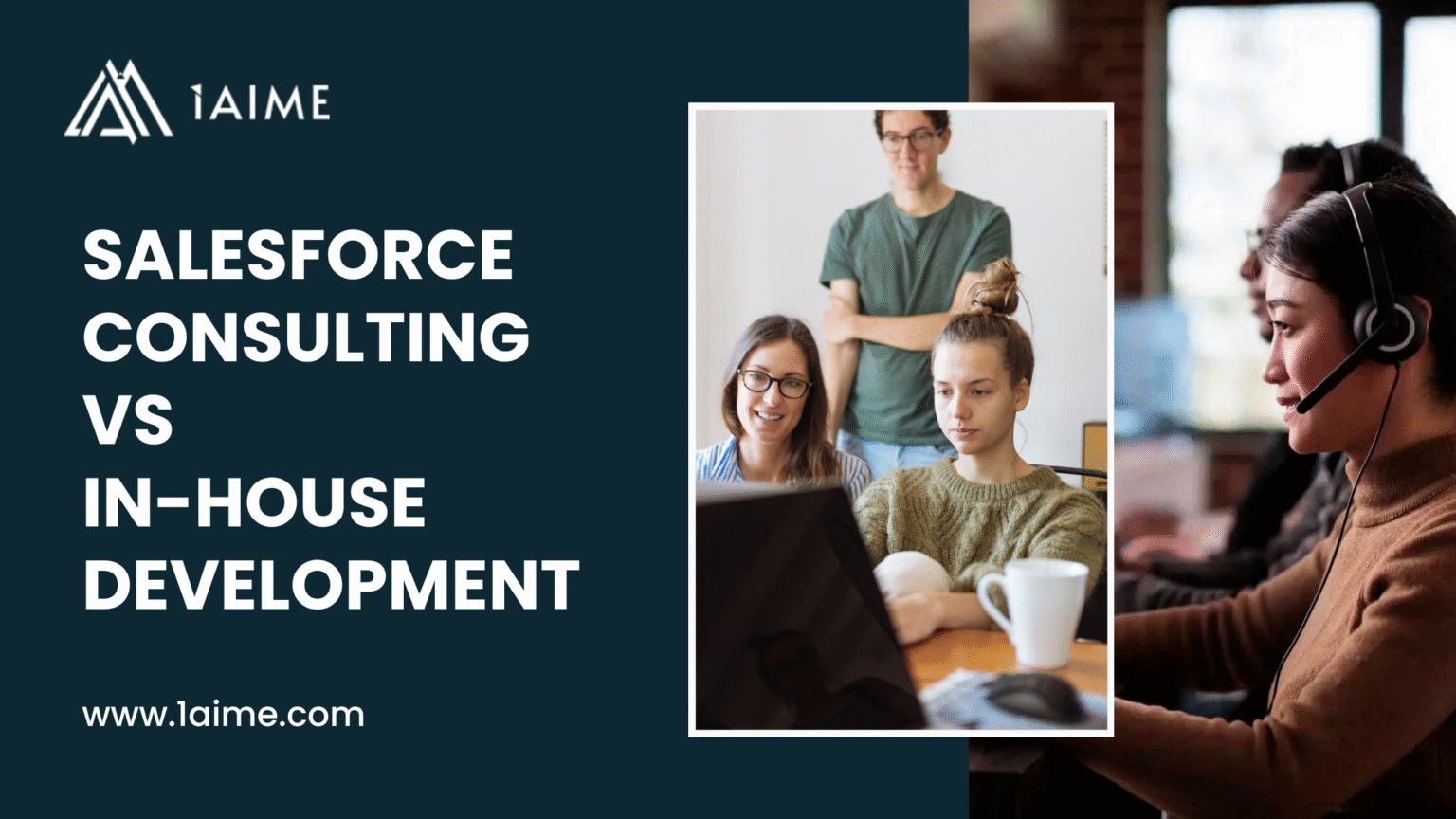
Every organisation reaches a point where Salesforce stops being a software rollout and becomes a board-level decision. The choice is clear yet complex: invest in an internal team or rely on consulting expertise. The path you take defines how fast you capture value, how well you scale, and how effectively you align Salesforce with strategic goals.
The question cannot be treated as a staffing exercise. Salesforce implementation sets the foundation for customer experience, revenue operations, and long-term digital strategy. In-house development offers control and cultural alignment. Salesforce consulting brings depth, speed, and industry-leading practices. Choosing the right approach means weighing cost, capability, and long-term vision against the realities of your business.
This guide explores both models in detail: what each delivers, where they fall short, and when hybrid approaches matter. The goal is not to push a one-size answer but to show leaders how to align their Salesforce investment with measurable outcomes.
What In-House Salesforce Development Looks Like
An in-house Salesforce team means direct ownership of the platform. Administrators, developers, and analysts work as employees inside the business, aligned with its culture and goals. Leaders often view this route as a way to safeguard knowledge and retain full oversight.
But building such a team requires long-term investment and a plan that accounts for cost, capability, and continuity.
How an In-House Setup Functions?
An internal setup usually covers three areas:
- Administration: User support, access control, and minor enhancements.
- Development: Custom code, integrations, and automation specific to the business.
- Architecture and Strategy: Planning how Salesforce scales across Sales, Service, CPQ, and other clouds.
Well, your company may start with a single admin, then add specialists once the platform expands. But remember that Salesforce success depends on clarity about which roles are essential at each stage.
Benefits of Internal Teams
- Control over configuration, data, and evolution of the platform.
- Cultural alignment since employees understand company language and workflows.
- Retained knowledge that strengthens long-term system ownership.
- Fast response to urgent needs when teams sit inside the organisation.
- Career growth pathways that turn employees into Salesforce leaders over time.
Challenges You Must Address
- Salaries, benefits, and certifications often push costs beyond £200K–£250K a year even for small internal teams.
- Recruiting certified Salesforce talent remains competitive, though salaries have eased in the current market.
- Scalability remains limited when each Salesforce cloud requires a dedicated specialist.
- Continuity risks arise when a key employee leaves without proper documentation in place.
- Project delivery slows when internal teams lack exposure to proven frameworks and industry methods.
When In-House Makes Sense?
The in-house path would suit your company if you have:
- Already employed Salesforce-certified staff.
- Running stable processes that do not require rapid expansion.
- Facing regulatory conditions that demand strict internal control.
- Holding the budget to invest in training and long-term staff development.
If your company expects fast evolution, multiple integrations, or frequent cross-cloud projects, you’ll end up stretching your internal teams too far. Therefore, it is best to empower your in-house team, taking help from a reliable consulting partner.
What Salesforce Consulting Partners Bring
A Salesforce consulting partner provides immediate access to certified expertise, proven delivery methods, and cross-industry experience. Partners design, implement, and optimise Salesforce environments at pace, drawing from a portfolio of previous projects. Instead of building capability slowly through internal hiring, you engage a ready-made team with breadth across Sales Cloud, Service Cloud, CPQ, and beyond.
To dive deeper into how Salesforce consultants and architects differ in responsibilities and impact, explore our Salesforce Consultant vs. Salesforce Architect
How a Consulting Partner Operates?
A consulting firm supplies a project-based or managed service model. Engagement can cover:
- Implementation: End-to-end design, configuration, and rollout.
- Custom Development: Advanced integrations and platform extensions.
- Change Management: Training and adoption strategies for end users.
- Optimisation: Continuous improvement as Salesforce releases new features.
Partners assign specialists to each domain, so you access architects, developers, and analysts without committing to permanent hires. This depth allows faster scaling and lower risk during complex projects.
Benefits of Engaging a Partner
- Access to certified experts across all major Salesforce clouds.
- Faster implementation through accelerators, templates, and best practices.
- Industry insights that highlight pitfalls and proven solutions.
- Flexible engagement models that adjust cost based on scope and demand.
- Structured adoption programs that drive user confidence and ROI.
- Risk reduction in areas like data migration, compliance, and security.
Challenges You Must Prepare For?
- Upfront Investment: Consulting partners often require higher initial fees compared with building capacity in-house over time. The trade-off is faster delivery and reduced risk of rework.
- Reduced Direct Control: External consultants operate independently, which means less oversight on day-to-day execution unless a structured governance model is in place.
- Communication Overhead: Success depends on alignment. Regular check-ins, detailed requirements, and clear escalation paths are critical for avoiding gaps between business needs and delivery.
- Knowledge Transfer Risk: Without a formal program for documentation and training, internal teams may struggle once consultants step away.
- Partner Variability: Consulting quality differs widely. Rigorous due diligence and reference checks are essential before engaging.
- Program Structure Requirement: Effective collaboration demands strong internal resource management. Your SMEs must remain available, and capacity must be planned so consultants can align deliverables with real business input.
When Consulting Partners Fit Best?
A consulting partner suits companies that:
- Face complex multi-cloud rollouts or advanced integration needs.
- Lack internal expertise but need immediate enterprise-level support.
- Operate in industries with compliance requirements that demand seasoned architects.
- Seek rapid time-to-value and cannot afford drawn-out learning curves.
- Plan ongoing transformation programs where external bench strength ensures continuity.
For leaders under pressure to deliver scale, speed, and certainty, a consulting partner offers capability that an in-house team cannot match within the same timeframe. The strongest outcomes often come when consulting partners build the initial foundation and train internal staff to take ownership over time.
Cost Comparison and Total Cost of Ownership
| Aspect | In-House Development | Salesforce Consulting Partner | Quantified Example (Annual/3-Year) |
| Upfront Costs | Recruitment, onboarding, and infrastructure setup push initial costs high. | Engagement fees appear higher but cover expertise, accelerators, and proven delivery frameworks. | In-House: £40K–£65K setup Consulting: £25K–£40K engagement kickoff |
| Ongoing Expenses | Fixed salaries, benefits, training, certifications, and retention programs average £200K–£320K annually for a small team. | Flexible retainers or project-based fees range £100K–£200K annually depending on scope, with no benefits or HR overhead. | In-House: £250K–£320K per year (~£750K–£960K over 3 years) Consulting: £120K–£200K per year (~£360K–£600K over 3 years) |
| Scalability Costs | Adding new clouds or features requires hiring additional specialists, raising fixed costs. | Partners scale up or down based on demand, reducing waste during slower cycles. | In-House: +£80K–£120K per additional specialist Consulting: +£40K–£80K on-demand project fees |
| Risk Costs | Employee turnover creates knowledge gaps, delays, and potential downtime, which inflate hidden costs. | Risk is mitigated through certified teams, structured documentation, and knowledge transfer, though dependency on partner must be managed. | In-House: Knowledge loss costs £40K–£80K per departure Consulting: Minimal if SLA and knowledge transfer enforced |
| Total Cost of Ownership | Higher over time due to fixed labour and training overhead, even when platform demand is low. | More cost-efficient per outcome, especially during complex implementations or transformations. | In-House: ~£1M–£1.3M over 3 years Consulting: ~£450K–£850K over 3 years |
Signs You Need In-House Development
- You already employ certified Salesforce talent with cross-cloud exposure.
- Your business requires strict control over intellectual property and data security.
- Your Salesforce environment evolves gradually, without frequent major overhauls.
- You want cultural alignment and embedded knowledge of internal workflows.
- You have a predictable workload with consistent system requirements.
- You plan to invest in long-term career paths for Salesforce roles within your org.
Signs You Need a Salesforce Consulting Partner
- You lack in-house Salesforce expertise or certified talent is hard to recruit.
- Your project involves complex integrations, CPQ, or multi-cloud deployments.
- You face tight deadlines and require accelerated implementation.
- Your internal team is already stretched with other responsibilities.
- You want access to best practices, accelerators, and proven methodologies.
- You need ongoing optimization, change management, or global rollouts.
Is Hybrid Approach Suitable For Your Company?
Yes.
A hybrid Salesforce strategy places in-house ownership at the centre and extends capacity with external expertise. Even with a capable internal team, you cannot move forward without expert guidance from industry-certified consultants. Salesforce evolves at a pace that demands external insight, proven frameworks, and accelerators that in-house resources alone cannot supply.
You cannot rush into implementation or expansion without this support, as every shortcut risks cost overruns, missed functionality, and user frustration.
How Hybrid Works in Practice?
- Internal employees manage daily administration, reporting, and local support.
- A consulting partner guides architectural decisions, oversees high-risk integrations, and secures compliance in regulated industries.
- Consultants ensure your roadmap aligns with Salesforce’s evolving releases, while in-house staff embed those changes within business culture.
When Hybrid Is the Right Choice?
- Your organisation scales across multiple Salesforce clouds, requiring advanced architecture and industry templates.
- Your business faces critical programmes such as acquisitions, CPQ rollouts, or AI-driven automation.
- Your leadership recognises that internal capability must grow steadily under the direction of external specialists.
- Your roadmap demands both steady upkeep and rapid delivery against competitive deadlines.
Why Hybrid Delivers Strategic Value?
- Strategic Safeguard: Expert consultants prevent rushed implementation and enforce standards that secure long-term ROI.
- Continuity with Oversight: Internal staff retain cultural knowledge, consultants ensure alignment with best practices.
- Cost Efficiency: Fixed costs cover the base function, external fees scale with high-value projects.
- Risk Control: Critical integrations and compliance-heavy deployments receive specialist oversight.
Partner With 1AIME For AI Powered Salesforce Consulting
Well, one thing’s for sure: your organisation cannot move forward with a generic consulting firm. The needs around Salesforce now extend beyond simple deployments or managed services. It now demands modern approaches built around AI, data clarity, and real-time outcomes.
You cannot rush into implementation without expert direction, and you cannot rely on legacy methods when the future of Salesforce rests on intelligence and automation.
Therefore, 1AIME is here to be your strategic partner in the long run. We align Salesforce with C-Suite priorities, embed AI-powered frameworks, and deliver measurable impact across revenue, efficiency, and customer growth. Our consulting model is designed for enterprises that require speed, precision, and forward-looking architecture.
You can trust 1AIME for:
- AI First – We position Agentforce and predictive intelligence at the core of your Salesforce environment.
- Executive Alignment – Every design and every build connects directly with leadership goals.
- Industry-Proven – We serve all sectors where compliance, scale, and transformation require trusted methods.
- Future-Ready – Your Salesforce platform evolves with every release, every regulation, and every market shift.
We lead you with our expert insights combined with your organisation and Salesforce audit. So, go ahead and request AIMCheck audit or a 30-min consultation call. We’ll take away all your hassles and guide you to implement Salesforce the right way.