
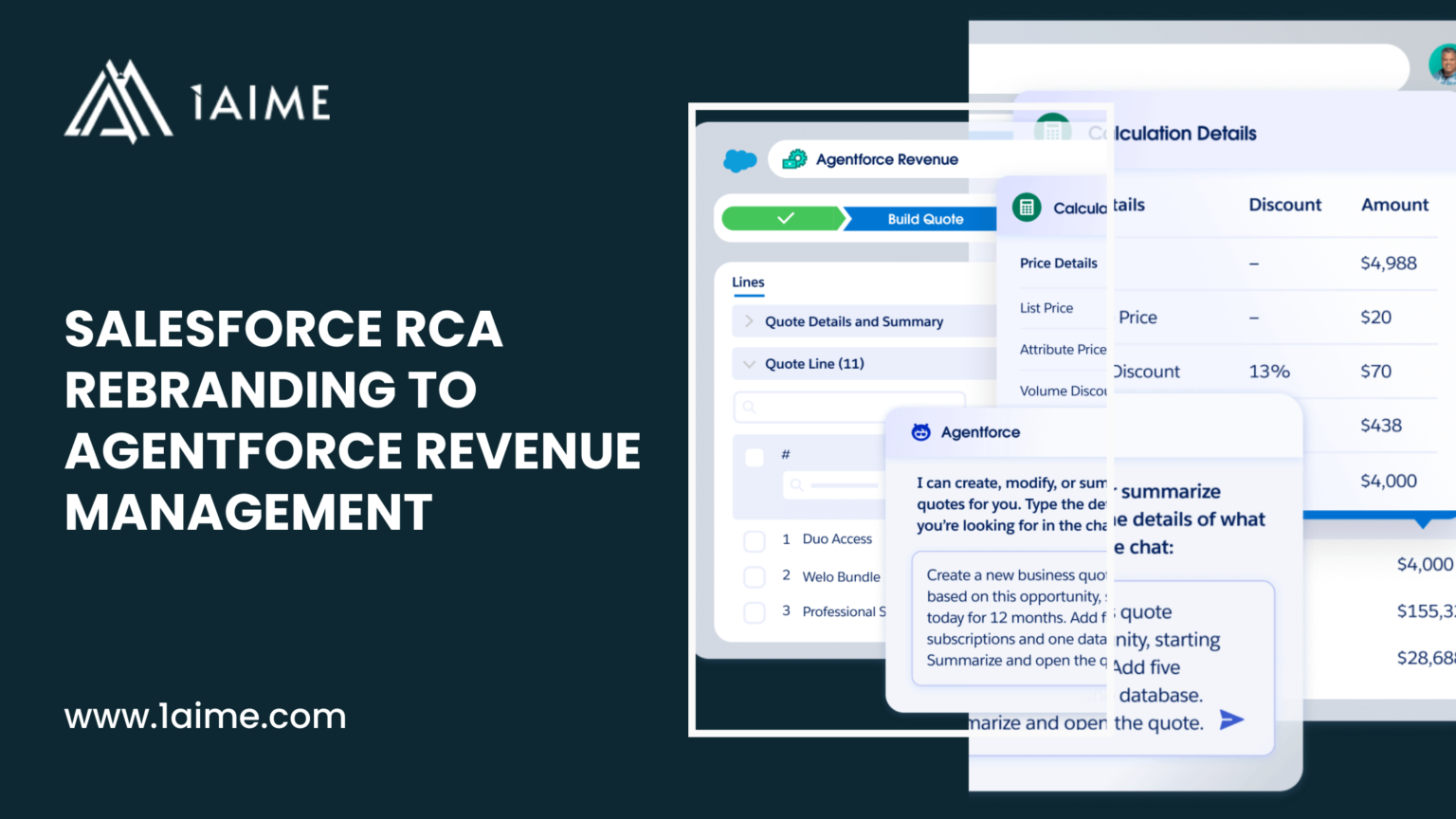
In October 2025, Salesforce announced the rebranding of Revenue Cloud Advanced as Agentforce Revenue Management. Notably, it repositioned revenue management within Salesforce’s AI strategy and elevated intelligence as a defining element of revenue operations.
The rebrand followed closely after Revenue Cloud Advanced had begun to gain market recognition. As a result, the announcement prompted immediate questions across enterprises and the partner ecosystem. Organisations sought clarity on whether the change represented a naming adjustment, a functional shift, or a change in operating expectations.
So now, enterprises face a practical interpretation challenge. Teams must reconcile strategic signalling with execution reality, maintain governance discipline, and avoid disruption to active programmes. Understanding the intent behind the rebrand has become essential to preserving confidence and continuity.
This guide critically examines RCA rebranding and its impact with precision. It distinguishes structural continuity from strategic acceleration. All while providing clear guidance on how enterprises should interpret and adjust without overcorrecting.
Why Salesforce Rebranded Revenue Cloud Advanced?
Salesforce rebranded Revenue Cloud Advanced as Agentforce Revenue Management as part of a broader enterprise strategy centred on Agentforce. Salesforce positioned Agentforce as a horizontal intelligence layer across its product portfolio, with AI agents embedded directly into operational workflows. Revenue operations became a natural extension of this strategy due to their cross-functional scope, transactional density, and proximity to business outcomes.
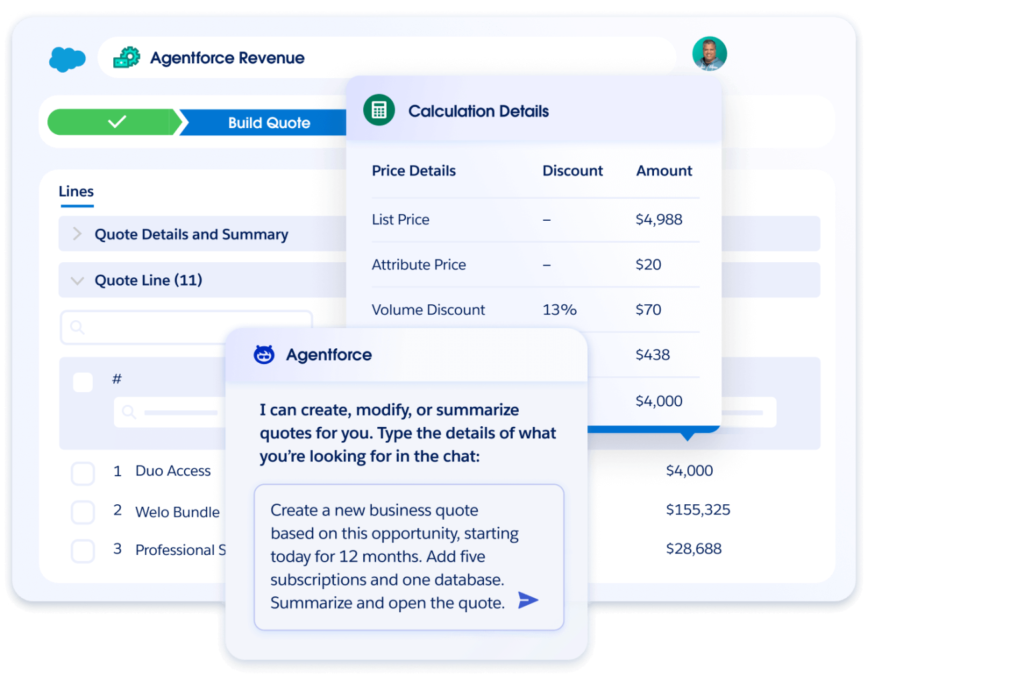
Notably, the rebrand did not coincide with a fundamental change in the underlying platform. Core capabilities such as unified quoting, contracting, ordering, and billing continued on the same native Salesforce architecture. The data model, execution flows, and configuration foundations carried forward from Revenue Cloud Advanced. The shift focused on emphasis and positioning rather than structural reinvention.
Salesforce also used the rebrand to signal long-term investment direction. Messaging evolved from revenue lifecycle consolidation towards agent-led execution. Agentforce Revenue Management framed revenue processes as active participants in decision-making rather than systems driven primarily by predefined automation. This positioned revenue management as a central pillar of Salesforce’s enterprise AI roadmap.
What the RCA rebranding clearly establishes:
- Alignment of revenue management with Salesforce’s Agentforce 360 strategy
- Emphasis on autonomous execution as the future operating model
- Continuity of platform architecture and core revenue capabilities
- Increased visibility of AI agents across revenue workflows
If we look at it from a more strategic perspective, Salesforce strengthened coherence across its enterprise AI narrative. Revenue management could not sit outside the Agentforce identity without fragmenting that story. From an execution perspective, the pace of rebranding shifted explanatory responsibility onto the ecosystem at a moment when consistency could have reinforced confidence.
The RCA rebranding therefore reflects a deliberate acceleration. Salesforce clarified its destination. Enterprises and partners now face the task of translating that destination into governed, practical execution.
Also Read: How to Manage Revenue Recognition in Salesforce
The Evolution Timeline: From RCA to Agentforce Revenue Management
Salesforce has rebranded its native, on-platform quote-to-cash offering multiple times in a relatively short period. From early 2024 through late 2025, the platform progressed through several identities as Salesforce refined both its product strategy and market positioning.
This evolution reflects a combination of architectural transition, branding consolidation, and strategic alignment with enterprise AI initiatives led by Salesforce.
Early 2024: Revenue Lifecycle Management (RLM)
Revenue Lifecycle Management launched in early 2024 with the Spring ’24 release. Salesforce introduced RLM as the native, on-platform successor to its traditional managed-package approach to quote-to-cash.
At this stage, the emphasis rested on signalling a foundational shift.
- Native implementation on the Salesforce core platform
- Move away from managed-package dependency
- Lifecycle-oriented framing of revenue from offer to billing
- Positioning as the future replacement path for legacy CPQ
RLM functioned primarily as a foundational label that established architectural intent rather than long-term branding.
Late 2024: Revenue Cloud Advanced (RCA)
By Dreamforce 2024, Salesforce repositioned the offering under the name Revenue Cloud Advanced. This change aligned the product more closely with the broader Revenue Cloud portfolio and clarified its place within Salesforce’s commercial suite.
The RCA name gained wider adoption across documentation, partner conversations, and customer engagements.
- Stronger alignment with the Revenue Cloud brand
- Clearer SKU identity for enterprise customers
- Reinforcement of platform maturity and readiness
- Continued focus on native, unified quote-to-cash execution
This phase marked the point where the platform achieved market recognition and naming stability, albeit briefly.
Late 2025: Agentforce Revenue Management (ARM)
By October 2025, Salesforce began transitioning the product name to Agentforce Revenue Management. This shift occurred as part of a broader, company-wide effort to align core products under the Agentforce umbrella.
The change coincided with Salesforce’s push to position AI agents as central actors across enterprise workflows.
- Alignment with Salesforce’s Agentforce and Agentforce 360 strategy
- Reframing revenue management within an AI-led execution narrative
- Continuation of the same native platform foundation
- Emphasis on future-facing positioning rather than structural change
At this stage, the naming focused less on platform consolidation and more on strategic direction and intent.
Also Read: A Comprehensive Guide to What is Salesforce Go
Is This Only a Name Change or a Capability Shift Also?
The transition from Revenue Cloud Advanced to Agentforce Revenue Management reflects both continuity and directional change. The underlying revenue platform, architecture, and lifecycle coverage remain largely consistent.
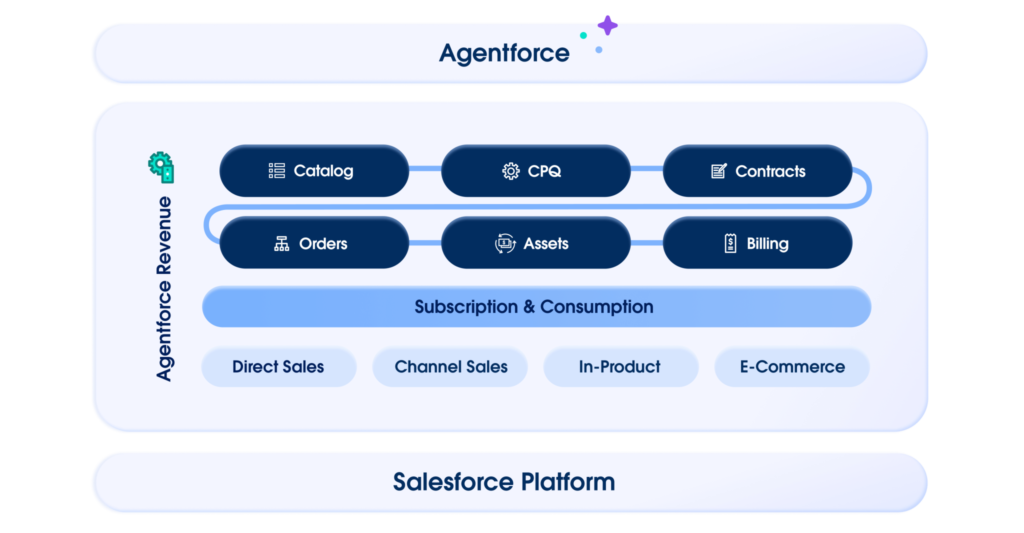
However, Salesforce has shifted how the platform is positioned, prioritised, and framed within enterprise operations. The rebrand elevates execution intelligence from an embedded capability to a defining characteristic.
This distinction matters because organisations tend to plan, invest, and govern platforms based on stated intent as much as current functionality. As a result, even where capabilities remain stable, expectations, adoption strategies, and operating models begin to shift.
| Area | What Changed | Why Salesforce Changed It | Impact on RevOps |
| Product Identity | Revenue Cloud Advanced renamed to Agentforce Revenue Management | Alignment with Salesforce Agentforce 360 and enterprise AI strategy | Requires internal and external clarification of scope and product identity |
| Strategic Positioning | Revenue execution reframed as agent-led rather than platform-led | To signal a future centred on autonomous, intelligence-driven operations | RevOps teams reassess long-term operating models and capability maturity |
| Market Messaging | Shift from lifecycle unification to execution intelligence | To position revenue closer to decision-making and business outcomes | Buyer expectations adjust around autonomy, speed, and intelligence |
| Adoption Narrative | Emphasis moves from consolidation to orchestration and action | To differentiate from traditional automation narratives | Change management effort increases across sales, finance, and IT |
| Investment Signal | Clear prioritisation of agent-driven roadmap direction | To guide customers toward long-term AI alignment | Organisations plan readiness rather than immediate transformation |
| Ecosystem Interpretation | Greater ambiguity between current capability and future intent | Branding acceleration outpaced enterprise adoption cycles | Consulting and RevOps leaders spend more time translating intent |
The Strategic Implications of Salesforce Adding “Agentforce” to Revenue Management
- Revenue execution now falls under Salesforce’s enterprise AI framework. Revenue management operates within the same intelligence strategy governing sales, service, and operational workflows.
- Autonomous revenue execution has become a declared strategic direction. Salesforce positions revenue processes as candidates for agent-driven decision support and execution over time.
- Branding now establishes future expectations rather than current capability. The Agentforce name communicates strategic intent ahead of broad enterprise operational maturity.
- Revenue platforms are reframed as decision-enabling systems. Salesforce presents revenue management as an active contributor to commercial decision-making rather than transactional processing.
- Organisational change requirements have increased. Leadership teams must guide interpretation, governance, and adoption sequencing across revenue functions.
- Technology evaluation criteria will expand. Platform assessment now includes AI governance, accountability, and decision control, in addition to functional coverage.
- RevOps leadership responsibility broadens. Revenue Operations leaders assume accountability for agent oversight, outcome quality, and operational discipline.
- Short-term reliance on advisory and consulting partners will rise. Enterprises require structured interpretation to align roadmap direction with execution reality.
- Strategic alignment has been prioritised over naming continuity. Salesforce favoured long-term platform coherence over short-term terminology stability.
- Executive focus must remain anchored on operating outcomes. Sustainable value depends on architecture, governance, and execution consistency rather than branding cycles.
Also Read: What Are Modern Salesforce-Native CPQ Platforms?
What is the Impact of RCA Rebranding to Agentforce Revenue Management?
Salesforce positions Agentforce Revenue Management as an execution layer where AI agents actively participate across the quote-to-cash lifecycle. This positioning materially changes how Revenue Operations and Revenue Management functions are expected to operate, even when core platform components remain familiar.
Revenue Operations Moves from Workflow Ownership to Execution Orchestration
Salesforce explicitly frames Agentforce as generating quotes, managing renewals, monitoring consumption, and explaining invoices. As a result, Revenue Operations no longer operates purely as the owner of workflows and hand-offs.
Revenue Operations now governs how execution happens across channels and revenue models.
What changes in practice
- Quote creation shifts from manual initiation to agent-initiated generation
- Renewal management becomes continuous rather than event-driven
- Consumption monitoring operates as an ongoing execution signal rather than a reporting activity
Operational impact: Revenue Operations defines orchestration rules, approval thresholds, and intervention points for agent-initiated actions across sales, finance, and fulfilment.
Revenue Management Shifts from Rule Enforcement to Outcome Supervision
Salesforce positions pricing, bundling, amendments, and renewals as agent-assisted activities supported by unified product catalogues and pricing logic. This reframes Revenue Management from enforcing static rules to supervising outcomes produced by guided and automated execution.
What changes in practice?
- Pricing strategies rely on agent-driven recommendations informed by account context
- Bundling and discount logic operate dynamically within defined guardrails
- Amendments and renewals occur at multiple points in the customer lifecycle
Operational impact: Revenue Management teams focus on margin protection, consistency, and predictability rather than expanding rule complexity.
Decision Velocity Increases Without Transferring Accountability
Salesforce emphasises faster quote generation, AI-assisted contracts, and automated order orchestration. These capabilities accelerate execution speed. Ownership of decisions remains human.
What changes in practice?
- Quotes and orders progress faster across channels
- Contract updates occur at more stages of the lifecycle
- Billing explanations and analytics surface in near real time
Operational impact: Revenue Operations and Finance introduce clear approval hierarchies and escalation models to preserve accountability while maintaining speed.
RevOps Governance Expands Across the Full Revenue Lifecycle
Salesforce positions Agentforce Revenue Management as unifying quoting, contracting, ordering, fulfilment, billing, and analytics on one platform. This removes traditional system boundaries that previously segmented ownership.
What changes in practice?
- Governance spans sales, finance, legal, fulfilment, and analytics
- Order orchestration and downstream initiation fall under RevOps oversight
- Billing accuracy and revenue analytics operate as part of execution, not post-processing
Operational impact: Revenue Operations becomes the coordinating authority for lifecycle governance rather than a downstream optimisation function.
Metrics Shift from Throughput to Quality and Consistency
Salesforce highlights revenue analytics across pricing, subscriptions, orders, and billing. These analytics reposition success measurement away from volume alone.
What changes in practice?
- Quote speed shares priority with pricing accuracy
- Renewal timing shares priority with renewal quality
- Revenue reporting accuracy shares priority with revenue growth
Operational impact: RevOps dashboards expand to include execution quality, margin stability, and lifecycle continuity.
How Enterprises Should Interpret the RCA Name Change?
Enterprises should interpret the rebranding of Revenue Cloud Advanced to Agentforce Revenue Management as a directional signal, not an operational requirement. The change indicates Salesforce’s prioritisation of agent-led execution within revenue processes, while the core platform and delivery model remain stable.
The correct response involves controlled interpretation rather than accelerated adoption.
How to interpret the change?
- Treat the rebrand as confirmation of Salesforce’s future investment direction
- Separate current deployed capability from forward-looking positioning
- Recognise that agent involvement increases execution speed, not ownership
- Assume continued human accountability for revenue decisions
How to adjust operationally?
- Preserve existing implementation and transformation roadmaps
- Define explicit boundaries for agent-assisted actions in quoting, renewals, and billing
- Formalise approval thresholds and escalation paths for agent-initiated activity
- Assign RevOps responsibility for agent oversight and outcome monitoring
What to prioritise immediately?
- Data quality across products, pricing, contracts, and assets
- Consistent lifecycle definitions across sales, finance, and fulfilment
- Auditability of pricing, renewal, and billing decisions
What to avoid?
- expanding scope based on naming alone
- assuming autonomous execution without governance readiness
- conflating roadmap intent with current capability
Executive guidance
The RCA name change clarifies Salesforce’s destination. Enterprises retain control over timing and execution. Organisations that respond with governance discipline and architectural focus extract value without introducing delivery risk.