
If your organisation runs on Salesforce, AI adoption is no longer experimental, but in fact, operational. Decisions made today will shape how pricing, contracts, renewals, and revenue integrity function tomorrow. Right?
Many teams approach the ChatGPT vs Agentforce discussion as a tool comparison, which is nothing short of a mistake.
The real question is not whether ChatGPT or Agentforce is more powerful. The real question is where intelligence should live, where execution must remain controlled, and how Salesforce continues to function as the system of record as AI becomes more capable.
It is mandatory for you to fully grasp the difference between ChatGPT and Salesforce Agentforce. Because one helps teams think better whereas the other ensures the business runs correctly.
Also Read: What Salesforce RCA Rebranding to Agentforce Revenue Management Really Signals?
Before exploring further, it is important to ground this discussion in a clear comparison.
| Dimension | ChatGPT | Agentforce |
| Core purpose | Reasoning, language understanding, planning, and analysis | Governed execution inside Salesforce |
| Primary role | Advisory and intelligence layer | Execution and control layer |
| Relationship to Salesforce | External to Salesforce | Native to Salesforce |
| Understanding of Salesforce | Understands data retrieved via APIs | Understands Salesforce as a live operating system |
| Ownership of customer state | Does not own customer or pipeline state | Owns and operates on customer and revenue state |
| Permissions and security | Access defined externally via connectors | Enforces Salesforce role, profile, and permission model |
| Workflow execution | Cannot trigger Flows or approvals natively | Executes Flows, Apex, approvals, and validations |
| Transaction boundaries | Operates outside Salesforce transactions | Executes within Salesforce transaction model |
| Auditability | Requires custom logging | Native audit trails and governance |
| Revenue Management fit | Analysis, scenario planning, explanation, insight generation | Pricing enforcement, approvals, amendments, renewals |
| Risk profile | Low execution risk, high flexibility | High control, low operational risk |
| Best use | Helping teams decide what should happen | Ensuring what happens is correct and compliant |
ChatGPT: Reasoning, Language, and Intelligence Outside Salesforce
ChatGPT functions as an external reasoning layer designed to support understanding and decision preparation. Language comprehension, contextual interpretation, and information synthesis define the primary capability. As a result, complex enterprise situations gain clarity before decisions move forward.
In a Salesforce-powered organisation, Salesforce remains the operational core. Customer data, permissions, workflows, and transactions stay under platform ownership. In this context, ChatGPT contributes upstream by improving interpretation before execution begins. Decisions gain context, and alignment strengthens across teams.
To extend that understanding beyond individual systems, MCP connectors provide structured access to Salesforce data and APIs. That access enables record retrieval and cross-system reasoning. At the same time, execution authority stays anchored to Salesforce. Insight expands without altering operational control.
As organisations adopt ChatGPT, value appears during moments that require interpretation rather than action. Communication clarity improves. Complex information becomes easier to understand. Alternative paths become visible before commitment occurs. Preparation becomes deliberate rather than reactive.
At this stage, ChatGPT supports organisations through:
- Interpretation of written communication and structured content
- Synthesis of large volumes of information into insight
- Explanation of complex logic using clear language
- Comparison of alternative scenarios and outcomes
- Preparation for informed decisions
Meanwhile, Salesforce continues to govern execution across the enterprise. Pricing logic, approval models, workflow orchestration, and auditability remain enforced through native controls. Operational integrity stays intact as intelligence improves upstream.
Notably, this separation exists by design. Reasoning benefits from flexibility and broad context. Execution requires governance and accountability. Through MCP, reasoning quality improves via expanded visibility. Through Salesforce, control remains enforced through established mechanisms.
So, for Salesforce-powered organisations, ChatGPT serves as a preparation layer rather than an execution engine. Understanding improves first. Decisions follow with confidence whereas action proceeds through Salesforce with control intact.
Agentforce: Execution, Control, and Governance Inside Salesforce
Salesforce Agentforce serves as Salesforce’s execution layer for AI-driven work. The platform enables autonomous and assisted agents to act directly inside Salesforce using native data, permissions, workflows, and transaction controls. Enterprise processes progress through governed action rather than external automation.
Salesforce continues to operate as the system of record. Agentforce works on live business state rather than copied or cached data. Every action follows established platform rules and remains visible through audit trails, approval histories, and execution logs. Trust emerges from execution inside the platform rather than orchestration outside it.
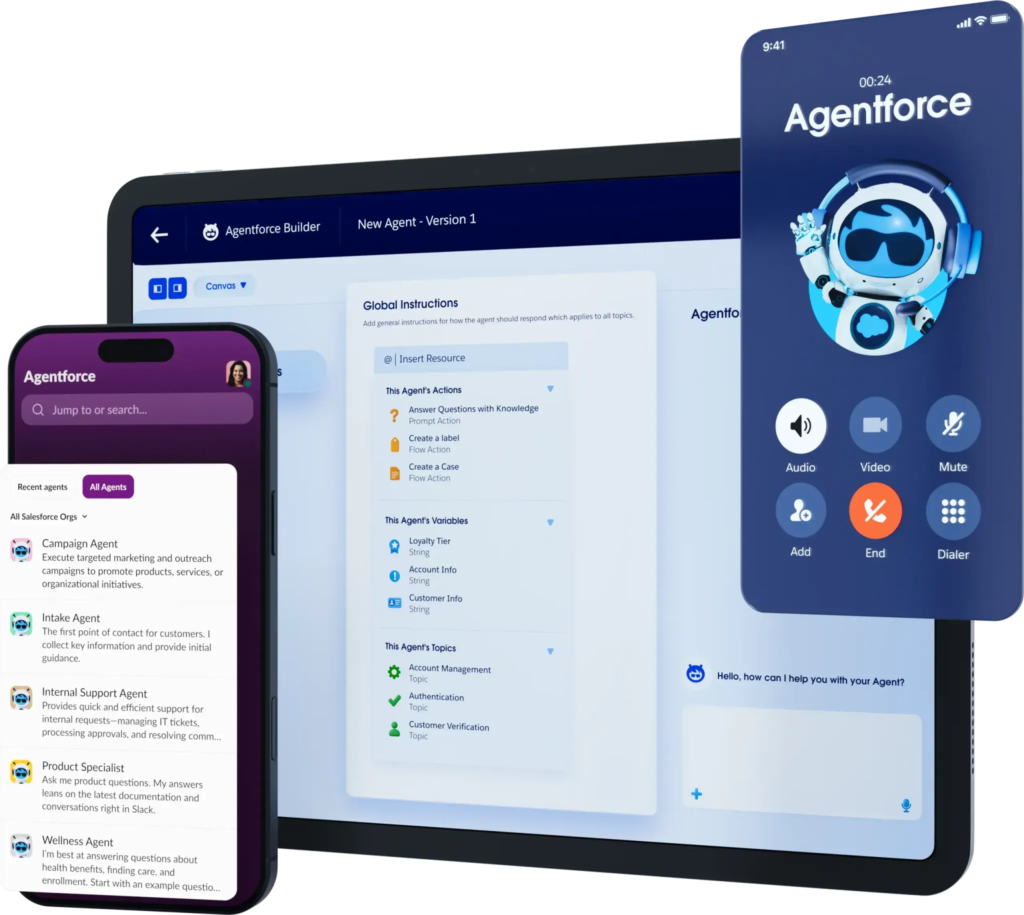
Core features of Agentforce
Agentforce provides execution capability through a set of platform-native features.
- Native access to Salesforce data across standard and custom objects
- Inheritance of Salesforce role, profile, and permission models
- Built-in enforcement of validation rules and approval processes
- Deep integration with Salesforce Flows, Apex, and event frameworks
- Transaction management to preserve data integrity across actions
- Auditability through logs, history tracking, and governance controls
- Human escalation paths for exceptions and judgement-based decisions
Core functions performed by Agentforce
Agentforce focuses on action rather than analysis. Execution occurs within defined boundaries.
- Updating records across Sales, Service, Marketing, Commerce, and Operations
- Progressing opportunities, cases, contracts, and operational workflows
- Applying pricing rules, discount logic, and policy enforcement
- Triggering approvals and conditional automation
- Coordinating cross-cloud processes through APIs and events
- Managing execution outcomes with visibility and traceability
How Salesforce organisations use Agentforce?
Salesforce-powered organisations use Agentforce once decisions reach the execution stage.
- Sales teams rely on Agentforce to move opportunities forward and apply commercial rules
- Service teams use Agentforce to route work and coordinate resolution flows
- Operations teams depend on Agentforce for consistent cross-cloud execution
- RevOps teams trust Agentforce to enforce policy and preserve revenue integrity
- IT teams use Agentforce to reduce custom automation and execution risk
How Agentforce helps Salesforce organisations scale?
Agentforce improves execution quality as volume and complexity increase.
- Automation replaces repetitive manual steps without bypassing controls
- Policy enforcement stays consistent across users and regions
- Approval flows activate automatically at the correct thresholds
- Exceptions surface clearly rather than accumulating silently
- Operational effort shifts from monitoring execution to improving outcomes
How Agentforce integrates with conversational AI?
Conversational AI introduces intent and direction. Agentforce converts that intent into governed action inside Salesforce. Context flows from the conversation into the system of record. Execution proceeds through native platform controls rather than external scripts. Productivity increases while governance remains intact.
For Salesforce-powered organisations, Agentforce defines where execution belongs. Intelligence may originate in multiple places. Action completes inside Salesforce. Control remains consistent as AI becomes operational across the enterprise.
Also Read: How to Manage Revenue Recognition in Salesforce
ChatGPT vs Agentforce: Which is Better for Your Organisation?
For Salesforce-powered organisations, the question is rarely about which AI is more impressive. The real issue is deciding where intelligence should live and where execution must remain controlled. AI introduces speed and flexibility, but Salesforce exists to preserve accuracy, governance, and trust. Any comparison between ChatGPT and Salesforce Agentforce needs to start from that reality.
Now place yourself in a real situation inside your organisation.
For instance, a high-value deal is nearing closure. Multiple products appear on the quote. Discount thresholds vary by region. Margin protection rules apply. Approval levels differ based on deal size. Revenue leadership needs confidence before anything moves forward.
At this point, your organisation needs clarity before execution.
How ChatGPT helps your organisation and where it doesn’t?
ChatGPT helps your organisation think through complexity before committing to action. It works best when your teams need understanding, explanation, and preparation.
ChatGPT helps your organisation by:
- Explaining pricing rules, discount policies, and approval logic in simple language
- Analysing historical deals retrieved through structured access to Salesforce data
- Highlighting margin impact across different deal structures
- Comparing alternative pricing or contract scenarios
- Helping sales and RevOps teams align before decisions are made
ChatGPT gives your organisation confidence at the decision stage. Teams understand why a deal should move forward in a certain way.
However, keep in mind…
ChatGPT stops at recommendation. Policy enforcement, approvals, record updates, and workflow execution belong elsewhere. At this point, your organisation must move from thinking to doing.
How Agentforce helps your organisation?
Salesforce Agentforce takes over when decisions require action. Agentforce operates inside Salesforce and executes work using platform governance.
Agentforce helps your organisation by:
- Applying pricing rules and discount thresholds automatically
- Triggering approval workflows at the correct stages
- Updating quotes, opportunities, contracts, and renewals
- Enforcing role-based permissions and validations
- Maintaining audit trails and transaction integrity
Agentforce ensures that execution follows policy every time, even as deal volume and complexity increase.
How your organisation uses both together?
High-performing Salesforce organisations do not choose one over the other. They sequence them deliberately. Your organisation:
- Uses ChatGPT to understand the situation and prepare the decision
- Applies human judgement to confirm direction
- Uses Agentforce to execute that decision inside Salesforce
This sequence reduces risk, prevents rework, and accelerates revenue execution.
Should You Use Both?
Yes. Use both, but for different moments in the same flow.
ChatGPT belongs before execution. It helps your organisation understand a situation, interpret information, compare options, and agree on direction. That work happens upstream, before anything changes inside Salesforce. Clarity improves, assumptions surface early, and decisions reach a higher quality.
Agentforce belongs at execution. It takes an approved direction and applies it inside Salesforce using permissions, workflows, approvals, and audit trails. Records update correctly, policies stay enforced, and outcomes remain traceable.
Using only ChatGPT leaves decisions unexecuted or inconsistently applied. Using only Agentforce forces teams to act without enough insight. Using both creates a clean sequence: ChatGPT sharpens the decision, humans confirm intent, and Agentforce executes with control.
How ChatGPT and Agentforce Work Together in a Salesforce Organisation?
| Stage of Work | What Your Organisation Needs | How ChatGPT Contributes | How Agentforce Contributes |
| Situation understanding | Clarity on a complex business scenario | Interprets context, summarises information, explains policies and constraints | — |
| Decision preparation | Confidence before committing to action | Analyses historical data, compares scenarios, explains trade-offs | — |
| Direction confirmation | Alignment across teams | Presents recommendations in clear language for human review | — |
| Policy enforcement | Consistent application of business rules | — | Applies pricing rules, discount thresholds, validations |
| Approval management | Correct approvals at the right time | — | Triggers approval workflows based on Salesforce logic |
| Execution | Reliable action inside Salesforce | — | Updates records, progresses workflows, executes transactions |
| Governance | Trust, auditability, and compliance | — | Enforces permissions, maintains audit trails |
| Scale | Performance without increased risk | Improves decision quality at volume | Preserves control as activity increases |
| Feedback loop | Continuous improvement | Explains outcomes and patterns for future decisions | Provides execution data for analysis |
Final Words
ChatGPT and Agentforce serve different roles in the same flow.
ChatGPT strengthens understanding before action begins. Agentforce applies decisions inside Salesforce with control and governance. One improves judgement whereas the other delivers execution. If used together, ChatGPT and Agentforce can create a clear path from insight to outcome, where intelligence guides direction and Salesforce governance protects results.